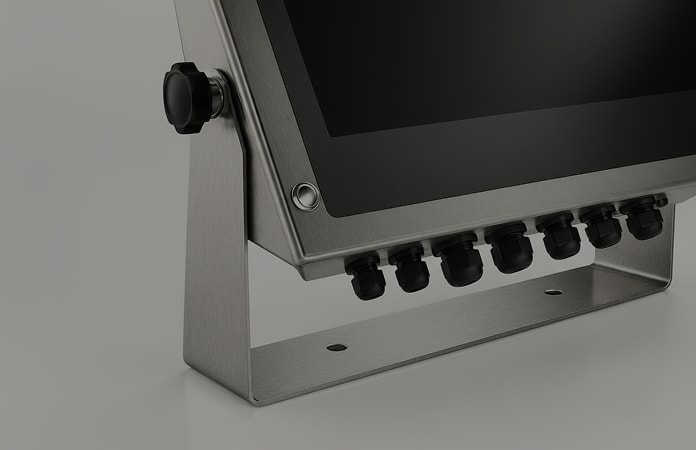
GRAM Pro™
Advanced
data weighing


Industrial scales are designed for precision – but even the most advanced systems can produce inaccurate results if they’re not used properly. At Gram Group, our Support & After-Sales (SAT) team has helped thousands of customers diagnose and prevent recurring weighing problems.
What we’ve learned is clear: most issues don’t come from faulty equipment, but from how it’s handled. And behind those mistakes are well-documented measurement principles – from gross to systematic to random errors.
In this post, we explain the most common weighing errors – and show you how to avoid them, based on real-life experience and metrological fundamentals.
Scales have maximum capacities, but that doesn’t mean every weight under that limit is safe. The risk often lies not in how much is placed on the platform, but how it’s placed.
Take this common SAT scenario: A user drops a 20 kg object from 15 cm onto the scale. That single impact creates a spike force far beyond the rated load, even if only for a millisecond. But that’s enough to damage the load cell permanently. The result? Drifting values, irregular readings – or a complete breakdown.
This is what we call a gross error: an avoidable, human-caused mistake with irreversible consequences.
How to avoid overload:
Over time, all measuring systems drift. That’s why calibration is not a luxury, but a necessity. Unfortunately, improper calibration is one of the most common errors we encounter.
A typical mistake is using the wrong reference weight. For example, Gram models require a weight equal to 1/3 of the maximum capacity, while Accurex systems require 2/3. Calibrating with an incorrect weight leads to systematic errors – small deviations that affect every measurement taken afterwards.
Worse, users often calibrate in unstable environments – on uneven surfaces, under vibration, or during temperature fluctuations – introducing further bias.
How to calibrate correctly:
Many users confuse Tare and Zero, and treat them as interchangeable functions. This creates one of the most overlooked but harmful weighing mistakes – especially in logistics, packaging, and process environments.
Tare is used to subtract and store the weight of a container, creating a clean net result. Zero, on the other hand, resets the display to zero – but without storing any value. It’s intended for small corrections, such as minor drift.
The problem? If Zero is pressed while a heavy object is already on the scale, the device will “accept” that load as zero, skewing all subsequent readings. This is a theoretical and user-based error, and a common source of hidden inaccuracies.
How to use Tare and Zero correctly:
Even if your equipment is properly calibrated and correctly used, the surroundings can silently degrade your results. This includes temperature changes, air currents, humidity, magnetic fields, and vibrations.
We’ve seen high-precision lab scales produce erratic readings just because they were placed near a window with a slight breeze. In industrial environments, forklift traffic or nearby compressors can cause subtle but constant vibration. These are classic examples of systematic environmental errors.
How to reduce environmental interference:
Not all errors are predictable. Random errors arise from uncontrollable, momentary changes: a power fluctuation, a brief voltage drop, or even operator fatigue. They don’t follow a pattern, but they can still skew your data.
These variations are often small – but in high-volume processes, they add up. That’s why it’s essential to understand that even a perfectly calibrated, carefully used scale can produce noise under certain conditions.
How to minimize random errors:
You’d be surprised how often a “broken” scale is simply a case of a drained battery. But what many customers don’t know is that some Gram models can continue to operate without a battery, as long as they’re plugged in.
This isn’t a long-term solution – but it can keep you running while a replacement arrives.
How to deal with battery issues:
At Gram Group, we don’t just sell weighing equipment – we help our partners build reliable, scalable processes. Understanding weighing errors is part of that. From overload damage to tare misuse, most problems are entirely preventable with the right knowledge and setup.
And if something does go wrong? Our SAT team is ready to help – not just with fixes, but with practical solutions that make your system better than before.